
Back to Expert Advice

Why This Guide Exists: AI Erased 101,820 Visits From Our Website Last Year
That’s a 31% drop in organic search traffic in 12 months. Real numbers, straight from our Google Analytics.
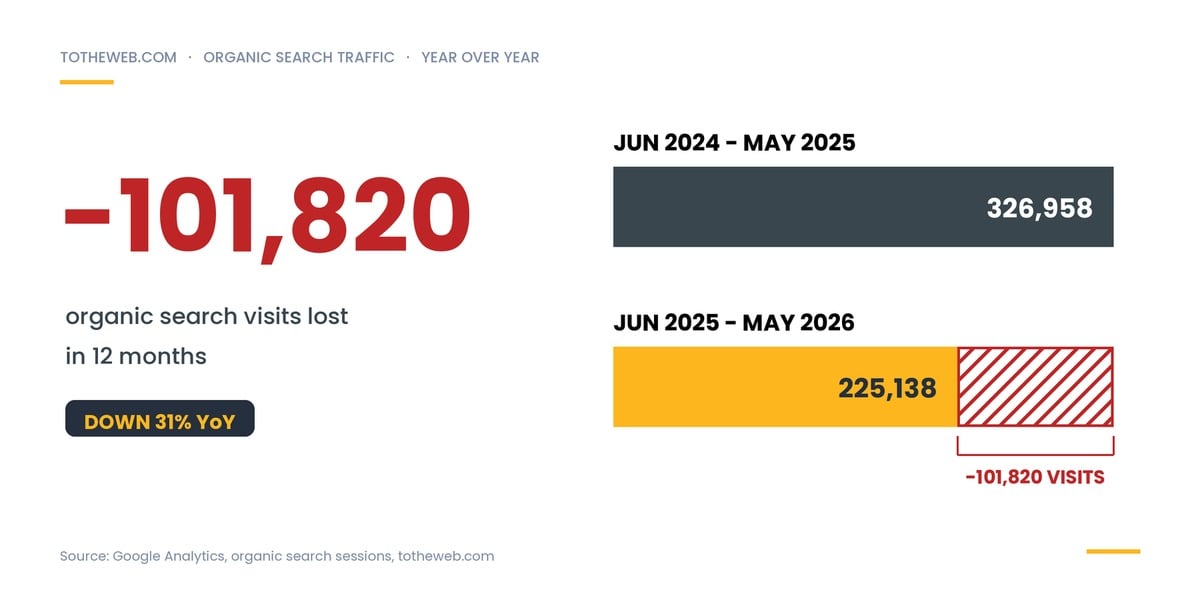
Replacing those clicks with Google Ads would cost roughly $535,000 a year at average CPC. B2B keywords run higher.
We run an answer engine optimization practice. We watch AI reshape search for clients every day. Our own data tells the same story.
The questions that used to bring people to websites now get answered inside ChatGPT, Perplexity, and Google’s AI Overviews. By 2026, fewer than a third of Google searches end in a click (SparkToro). That traffic is not coming back.
-31%
organic traffic
+23%
engagement per visitor
The tourists left. The buyers stayed.
Two moves matter now. Become the source AI cites. Build for the smaller, smarter audience that still shows up. This guide covers both.
Adapting to AI-Driven Search with Generative Engine Optimization (GEO)
Search didn’t die. It moved. Your traffic went with it.
Buyers stopped typing keywords into Google. They ask ChatGPT and Perplexity full questions and get full answers. Google now answers queries right on the results page. No click. No visit. No lead.
This is not a reason to abandon SEO. Answer engines pull their sources from search results. If you don’t rank, you don’t exist to them. SEO gets you in the room. GEO gets you quoted. The two disciplines overlap but they are not the same, and we break down how optimizing content for LLMs differs from SEO in a separate guide.
What This Guide Covers
- How LLMs and answer engines actually find and pick content
- Why ranking in Google and Bing still decides whether AI cites you
- 9 content techniques that increase your odds of being quoted
- Schema markup and technical signals AI systems read
- How to track your brand inside AI answers
Understanding AI-Search
| Traditional SEO | AI Search Optimization | |
|---|---|---|
| Goal | Rank pages in search results | Get cited in AI answers |
| What gets evaluated | The whole page: keywords, backlinks, technical health | Individual passages: clarity, structure, evidence |
| What wins. | Authority and relevance signals | Content that answers the question directly and can be quoted |
| The payoff | Clicks to your site | Citations, brand mentions, and the high-intent clicks that remain |
| How fast it changes | Algorithm updates, often unannounced | New model releases plus live web retrieval that updates constantly |
Where do AI systems get content from?
Two places. Get this distinction right and the rest of GEO makes sense.
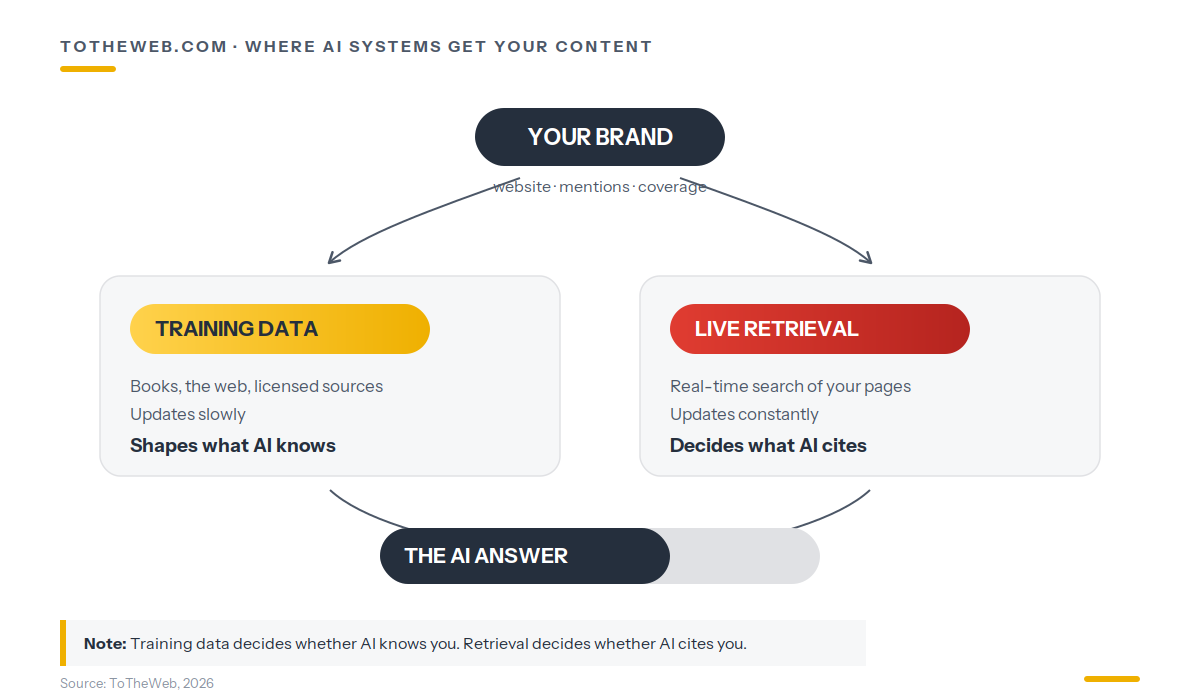
1. Training data. Models learn from books, code, and huge swaths of the web, plus licensed sources like Reddit and major news publishers. This shapes what AI knows about your brand. It moves slowly. You influence it by being mentioned across the web, not just on your own site.
2. Live retrieval. Ask ChatGPT, Perplexity, or Google’s AI Mode a question and they search the web in real time and quote what they find. Most citations come from here. It moves fast. You influence it with pages that rank, load clean, and answer the question near the top.
Training data decides whether AI knows you. Retrieval decides whether AI cites you. Most companies obsess over one and ignore the other.
How do AI answer engines find your content?
Two ways, and both matter.
They crawl. OpenAI, Anthropic, Perplexity, and Google all run their own bots: GPTBot, ClaudeBot, PerplexityBot, Google-Extended. If your robots.txt blocks them, you’ve opted out of AI visibility. Check this before you spend a dollar on GEO. We’ve seen companies pay for AI visibility consulting while their own site blocked respectful AI crawlers.
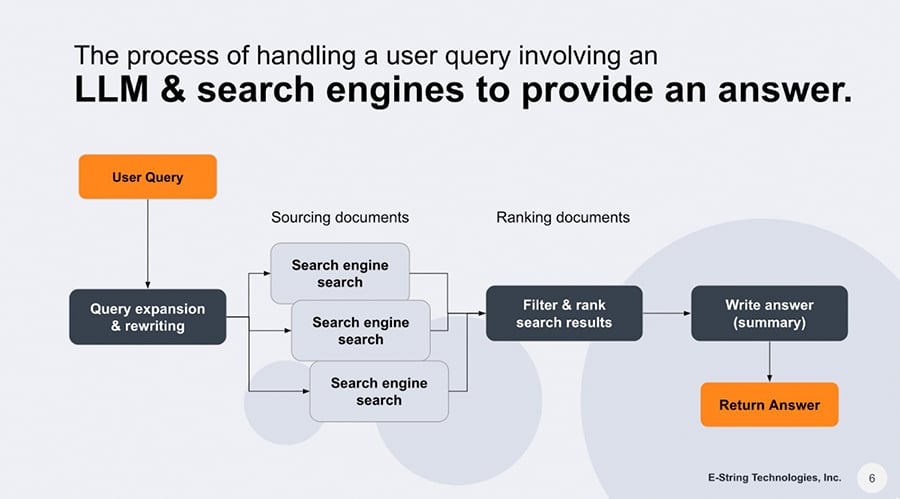
They retrieve on demand. When someone asks a question, the answer engine runs a live search, pulls the most promising pages, and quotes what answers the question. ChatGPT leans on Bing plus its own index. Perplexity built its own. Google’s AI Mode uses, well, Google.
Retrieval rewards pages that are easy to lift answers from:
- Clear structure with headings that match real questions
- A direct answer near the top, not buried under a 400-word warmup
- Clean HTML that’s easy to quote
Long pages are fine. Unscannable pages are not. If a model can’t find your answer in seconds, it quotes someone else.
Understanding LLM Behavior
Large Language Models (LLMs) are AI systems trained on vast text datasets to generate human-like language. Here’s the multi-step process they run when they search the web on your behalf:
The Changing Search Landscape
People search more and click less. In May 2026, Google’s AI Mode passed one billion monthly users within a year of launch, and Google reports total queries at an all-time high. Source:Google
AI Overviews and AI Mode resolve the question on Google’s page, and ChatGPT and Perplexity resolve it before Google is even involved. Google
That’s the math behind our own 31% drop. More questions asked. Fewer answered by a visit to anyone’s website.
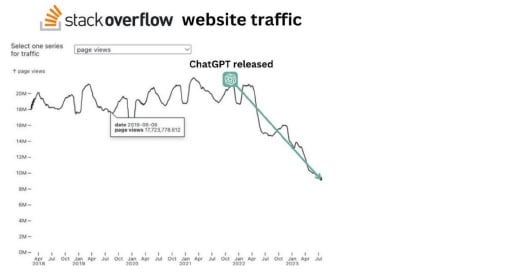
 “Massive change is coming, and we predict an SEO bloodbath,” warned Paul Baier, CEO of GAI Insights, in 2024. His forecast: 15 to 25% of organic search traffic would leave Google for LLMs within 24 months.
By mid-2025, Baier declared the bloodbath “well underway,” pointing to traffic at major publishers dropping by half while ChatGPT climbed into the world’s top five websites. Our analytics agree. He undershot.
Optimizing Content for Inclusion in LLMs
Practical tip: When creating content, imagine you’re building a mini-encyclopedia on your topic. This mindset will help you create the depth and breadth that LLMs can effectively utilize.
1. Create In-Depth, Comprehensive Content
LLMs prioritize thorough, well-structured information. Implement these tactics:
- Cover All Angles: Explore your topic exhaustively, including related subtopics. Showcase your deep knowledge of the topic. This comprehensive approach helps LLMs understand the full context.
- Include insights, analysis, and information that clearly establish your authority in the field.
- Aim for substantial word counts (e.g., 1500+ words for key pages) when appropriate to showcase comprehensive knowledge.
- Use Examples and Case Studies: Incorporate real-world examples and up-to-date data. This enriches your content and helps LLMs make accurate connections between concepts.
- Define Key Terms: Explain technical terms and jargon clearly. This ensures both human readers and AI systems can fully comprehend your content. Use semantically-related terms and concepts.
2. Build FAQ pages around real buyer questions
Your customers have already written your FAQ. The questions are sitting in sales calls, support tickets, and prospect emails.
Use their exact words. A buyer who asks your sales team “how long does onboarding take?” types the same question into ChatGPT. When your heading matches the prompt, you’re the answer.
Write the answers on the page first. Schema comes second and must mirror what’s visible. Format details are in the schema section below.
3. Write the Way Buyers Ask
LLMs are trained on natural language. Match it.
Use full questions, not keyword fragments. “How do I choose enterprise software?” beats “enterprise software solutions.” Pick strong verbs: “buy,” not “make a purchase.” Use contractions. Read it aloud. If it sounds like a brochure, rewrite it.
4. Optimize for Featured Snippets
Featured snippets show up less often now. AI Overviews have taken over many of the question-style queries that used to trigger them, and snippet visibility has dropped hard since 2024. Source: Keywords Everywhere
So why is this technique still here? Because the snippet became the audition. Pages that win snippets are the pages AI Overviews cite. The same patterns win both: clear question framing, a direct first-sentence answer, formatted lists and tables.
5. Structure content so answers are easy to lift
AI systems quote passages, not pages. Make every passage easy to find and extract:
- Write descriptive headings that match real questions. A heading like “How much does AI training cost?” gives the model a labeled answer to grab.
- Use bullet points and numbered lists. They extract cleanly.
- Keep paragraphs short. One idea per paragraph.
- Add descriptive captions to images and videos. Captions are the only part of your visuals most models read.
- Keep formatting consistent across pages so patterns are predictable.
6. Use Diverse Content Formats
Incorporate a mix of text, video, and images in your content. This diversity not only caters to different user preferences but also provides multiple ways for AI systems to understand and contextualize your information. Ensure each format complements the others, reinforcing your key messages across different mediums.
7. Enhancing Content Credibility, Authority, and AI Visibility
Establishing your Authority in AI Search results:
Research: Conduct and publish original research or data analysis to position yourself as a primary source.
Author Bios: Clearly state relevant qualifications in author bios to reinforce your expertise to both readers and AI systems.
Key strategies to implement:
- Credible Sources: Include expert quotes, case studies, and credible citations to improve visibility, add real-world context, and enhance trustworthiness.
- Fact-based information: Integrate relevant statistics and data to support the content, making it more informative and reliable.
- Readable and Clear Language: Optimize the fluency and simplicity of the text to enhance readability and understanding.
- Confident language: Make direct claims. “Schema markup improves AI comprehension” beats “schema markup may potentially help.” Hedged copy is harder to quote.
8. Enhancing Cross-linking for AI Search
To improve AI search visibility, create a well-connected content structure. Organize topics into clusters with pillar pages, use descriptive anchor text for internal links, and include related article sections. This approach helps AI systems better understand your content’s context and relationships, potentially boosting its relevance in search results.
9. Monitor Performance Across Both Traditional and AI-Powered Search Results
Rank trackers can’t see inside ChatGPT. You need an AI visibility platform. We use REVERE to track brand mentions, citations, and competitor share across the major AI engines.
Measure three things: are you mentioned, are you cited, and who wins the answer when you don’t.
Schema Markup and Technical SEO: Boosting AI Comprehension
1. Use Structured Data
Structured data gives search engines and AI systems machine-readable context. Your page says what it is instead of making the machine guess. Mark up the things machines get wrong: products and services, events and dates, organization details, and article type.
Practical tip: Apply it to text, images, and video, not just articles.
FAQ Schema Still Matters. The reason changed.
Google killed FAQ rich results for most sites in 2023. The old pitch, more SERP real estate, is dead.
The new pitch: FAQ schema hands AI systems your questions and answers as labeled pairs. No parsing needed. That’s the format answer engines want.
Write real buyer questions as headings. Answer in one or two sentences. That’s how people prompt ChatGPT.
Generate schema code with our free tool. No code needed. →
2. Title Tag Optimization: Balancing SEO and LLM Considerations
The 2024 Google Search API leak confirmed title tags matter for rankings. LLMs read them too, when crawling and when citing.
Write concise, keyword-rich titles that say what the page is.
Preview how your meta title and description tags will appear.
3. Optimize for Wide Distribution – go beyond Google
LLMs often recognize content that appears across multiple reputable websites. Aim to have your content cited, quoted, or referenced on various platforms to increase its visibility to AI systems. For example, increase your PR spend to get your message more widely distributed.
Danny Sullivan, Director within Google Search : ‘To succeed with Google Search, think beyond it.’
4. Encourage User Generated Content
AI engines cite Reddit threads, reviews, and forums constantly, often above brand websites. When buyers ask “is [your product] any good,” the answer comes from what your customers wrote, not what you wrote. Earn reviews on the platforms your buyers trust. Show up in the communities where your category gets discussed.
5. Optimize Video Content
YouTube is now the most-cited domain in Google’s AI Overviews, with citations up 34% in six months.
LLMs don’t literally watch footage; they read the text YouTube provides about the video: titles, descriptions, tags, chapters, captions/transcripts, and comments. Source: aHrefs
These 3 steps increase discoverability in both traditional search and AI-generated recommendations.
- Make those elements accurate and answer-focused so models can return your videos in responses.
- Use descriptive, question-based titles and chapter names. Upload or clean up transcripts instead of relying only on auto-captions.
- Add clear descriptions, targeted tags, and video sitemaps. Encourage likes, comments, and shares.
Guardrail: Don’t outsource quality to AI
Some ad networks have dropped publishers that flooded their sites with low-quality AI content.The problem isn’t using AI. It’s publishing repetitive, unedited content at scale.
When the marginal cost of creating new and customized content plummets, which it will as LLMs become even more capable, then content will explode, even more than it has today. The traditional web will be overwhelmed with AI generated content. The time to plan for this tsunami is now.
John Sviokla, Executive Fellow @ Harvard Business School | D.B.A., GAI Insights Co-Founder
These strategies enhance your content’s compatibility with LLMs. You’ll improve your chances of appearing in AI search results. This approach not only caters to AI systems but also creates more user-friendly content for human readers, potentially increasing engagement and reach.
GEO Checklist for AI Search Success
This essential guide helps your content get cited in AI engines.
Download the Checklist
Q&A from our Expert Panel
In July 2024, I hosted an AI Learning Lab panel with Alden Do Rosario (CEO, CustomGPT) and Julio Barros (President, E-String). Their fundamentals still hold, with one update. ChatGPT no longer relies on Bing alone. It blends Bing’s index with its own crawling, as covered earlier in this guide.
#1 – Can LLMs be influenced to reflect personal views or content for other people?
It’s a common belief that LLMs can be manipulated to consistently favor a specific viewpoint. We asked our panelists to weigh in: timestamp :2:54 min
- Yes, through data sources like Bing search and Common Crawl
- Limited control, depends on fixed knowledge and search tools
- Individual users can’t significantly influence LLMs
- Group behavior might influence LLMs over time
Alden Do Rosario
 The feeling is that, yes, it is similar to SEO. Large Language Models (LLMs) can indeed be influenced if you start appearing in their data sources. For example, if you look at ChatGPT, many of its data sources come through Bing search or Common Crawl. So, if you are able to get yourself indexed in Common Crawl or rank highly in Bing search results, you can potentially start showing up in ChatGPT responses.
We've been ignoring Bing. Historically, everyone has been optimizing for Google. How do we optimize for Google? We do backlinking, monitor our results, and make sure we're ranking number one for all the queries that matter. We've just been focusing on Google, Google, Google.
Now it's time to take a step back and say, "Okay, great, I'm ranking number one in Google, but am I ranking number one in Bing?" Because if you don't apply the same optimization strategies to Bing that you're using for Google, and if you're not making sure you're ranking number one in Bing, then you won't show up in ChatGPT results.
ChatGPT uses Bing as its search tool. So when you ask a question like "What is the weather today in San Francisco?", the LLM by itself doesn't have that knowledge. Under the hood, it will kick off a search to Bing.
--- Optimizing for Bing Search
Optimizing content for Bing search, while sharing some commonalities with traditional SEO practices used for other search engines like Google, involves some specific strategies due to differences in how Bing processes and ranks web content. Here are some key aspects that distinguish Bing SEO from traditional SEO practices:
- Keyword Usage and Page Titles
- Bing: Bing places a strong emphasis on the presence of exact keywords in titles, meta tags, and content. It is generally considered more literal in its interpretation of queries.
- Traditional SEO: While keywords remain important, there’s a stronger focus on relevance and context rather than just the exact match keywords.
- Backlinks
- Bing: Quality backlinks are important, but Bing also places significant value on the number of backlinks, viewing them as a key indicator of a page’s authority.
- Traditional SEO: The focus is more on the quality and relevance of backlinks rather than sheer quantity. Google, for example, emphasizes link quality much more heavily.
- Social Signals
- Bing: Social signals, such as shares and likes on social media, are explicitly mentioned by Bing as a ranking factor. This means that content popular on social networks can perform better in Bing’s search results.
- Traditional SEO: While social signals can indirectly affect rankings by driving traffic and engagement, they are not direct ranking factors in Google's algorithm.
- Technical SEO
- Bing: Bing has a strong preference for older, more established domains and clearly favors certain technical elements like a clear sitemap, which helps its crawler, Bingbot, index pages efficiently.
- Traditional SEO: While technical SEO is crucial across all search engines, Google, for instance, places more emphasis on mobile-first indexing and site speed.
- Multimedia Content
- Bing: Bing seems to index and understand multimedia content such as images and videos better than Google. Thus, having rich multimedia content can boost rankings more noticeably.
- Traditional SEO: Although multimedia enhances user engagement, it’s primarily the textual content that’s been traditionally emphasized for optimization.
- Local SEO
- Bing: Bing Places plays a significant role in local search results, and the integration with Microsoft’s mapping services means that having a well-optimized local presence is essential for visibility.
- Traditional SEO: Google Business Profile dominates local SEO strategy, with features like reviews, posts, and local citations playing a major role
Julio Barros
 There's very little control you can exert over the fixed knowledge base of language models. You might have slightly more influence over what happens when they use tools to search the internet, but even that would be very difficult to manipulate.
As LLMs evolve towards more agent-like technology, they may learn more about individual users' interests, preferences,and personal facts. They'll likely use this information to generate personalized answers. However, this personalization would only affect responses for that specific user, not for others.
These systems will have memory. They'll also have different kinds of system prompts that you can specify. For example, you can indicate that you prefer very academic answers or very simplistic answers, and that will affect what you see in your results. I don't believe this will affect what other people see.
To influence results for everyone, you'd need to impact either the training data or the search results themselves. I'm not sure how much one can influence the training data. As for influencing search results, that's more in line with traditional SEO and search engine optimization techniques.
#2 – Can repeated user interactions with an LLM shape its responses over time, potentially biasing it towards specific perspectives or information sources?
- Individual user interactions do not currently shape LLM responses over time
- LLMs don’t monitor user behavior like page visits or time spent on results
- While an individual can’t bias the model, group behavior at scale may influence LLMs over the long term
- Companies like OpenAI likely use aggregate user data to improve their models
- The potential for collective user influence raises ethical questions about LLM training and output
Julio Barros
It's important to think about what this question really means. Perhaps it's drawing a parallel to how Google works: if you quickly bounce from a page, Google may not rank that page highly anymore. Conversely, if you spend time viewing and examining a page, Google interprets this as a sign of quality and may give it a higher ranking.
The question seems to be asking if something similar happens with LLMs. However, I don't think this is really feasible, at least not with any LLMs we currently know of.
These systems just give you an answer; they don't necessarily monitor whether you visit a suggested page or how long you spend there.
Just because you like an answer or keep asking the same question doesn't mean that anyone else will see that result. The system might learn what you want, but not necessarily what anybody else wants.
Alden Do Rosario
I agree that the answer is no for an individual, but as a group, I would be shocked if over the long term the LLM cannot be influenced.
OpenAI will use every piece of data in its power to make its engine better, so if thousands of people are exhibiting certain behavior, I would expect OpenAI to learn from that.
Remember, a couple of months ago, ChatGPT itself was learning like crazy from all the behavior. The whole reason to make ChatGPT public was so that they could gather learnings from consumer behavior. So I would be really surprised if they aren't already doing it, or if they don't take group behavior into account.
However, I am pretty confident that you, as an individual, cannot sit there and do a thousand sessions with ChatGPT and say, for example, "Alden is the best cricket player in the world." If I sit there and do that all day long, it won't change the model's overall responses.
#3 – What influences an LLM’s decision to cite sources, and how does this reflect its understanding and information retrieval? <30 min>
- LLMs typically cite sources when they’ve used external tools like Bing search or partnerships with news/Reddit
- Without external tools, LLMs rely on their training data and don’t cite specific sources
- The decision to cite is often influenced by the system prompt given to the LLM
- ChatGPT is transparent about when it’s using external search, showing this to users
- Source citation reflects the LLM’s certainty about where specific information came from
Alden Do Rosario
Why does an LLM return citations sometimes and not others when it's the same query?
The answer likely lies in whether it used the search tool (Bing) or not. If it did not use the tool, the news corporation partnership, or the Reddit partnership, it will not cite a source. If it did use one of these, the model has a guarantee that a specific source was used and can cite it. Otherwise, it's just running its probabilistic math.
But if it used the tool - where the tool is the backend search done through Bing - then it can confidently say, "Okay, here's where I got the data from." That's the big difference.
I think ChatGPT is quite transparent about this. It will show you when it's triggering a search, and you can use the drop-down menu to see which URLs are being returned and things like that.
Julio Barros
What influences the decision to cite sources?
I think, taken literally, it would be the system prompt that's given to it to do the search. The prompt might say something like, "You will use this information to answer this question and make sure you cite the sources." So whatever information it uses, it will then be compelled to cite those sources.
Your next steps
- Lead with the answer. Put a direct answer at the top of every key page, under a heading that matches a real question.
- Add schema markup. FAQ schema hands AI your questions and answers as labeled pairs. Use our free FAQ Generator for this code.
- Keep ranking. Answer engines pull sources from search results. SEO is still the entry ticket.
- Measure AI visibility quarterly. Are you mentioned, are you cited, and who wins when you’re not.
AI is changing how buyers find you.
Last updated: 2026-06-29
This page is updated regularly as AI search, Google AI Overviews, and generative engine optimization practices change.

Rosemary Brisco

AI Training Videos
AI Visibility & Workflow Training
Make your brand easy for LLMs to find and quote.
Teach your marketers practical AI workflows that save hours and lift results.
Start by Training your Marketing Team