AI search has a different job. It selects sources, pulls out the useful parts, summarizes the answer, and may cite only a few pages.
That changes the job of your B2B website.
Here is what you will get from this article. You will learn how to tell if your pages are answer-ready. You will learn what to fix first. And you will learn how to measure it.
Your content is no longer competing only for rankings, clicks, and blue links. It is competing to become part of the answer buyers see before they ever reach your site.
For B2B enterprise websites, this is a bigger problem than most teams realize.
Many enterprise sites were built around internal priorities: product lines, business units, campaigns, gated assets, brand messaging, and sales narratives. That structure may work for navigation, but it often fails when buyers ask specific questions in AI tools.
AI systems need pages that explain clearly, answer directly, compare options, support claims, and make the source easy to trust.
Most enterprise websites do the opposite.
They bury answers inside long pages, vague positioning, PDFs, gated reports, disconnected product pages, and content written for campaigns instead of buyer questions.
If your page is vague, bloated, generic, or buried in marketing language, AI has little reason to use it.
If your page gives a clear answer, names the product, explains the category, supports claims, cites credible sources, and answers the next question, it has a better chance of being included.
The gap: most B2B websites are not answer-ready
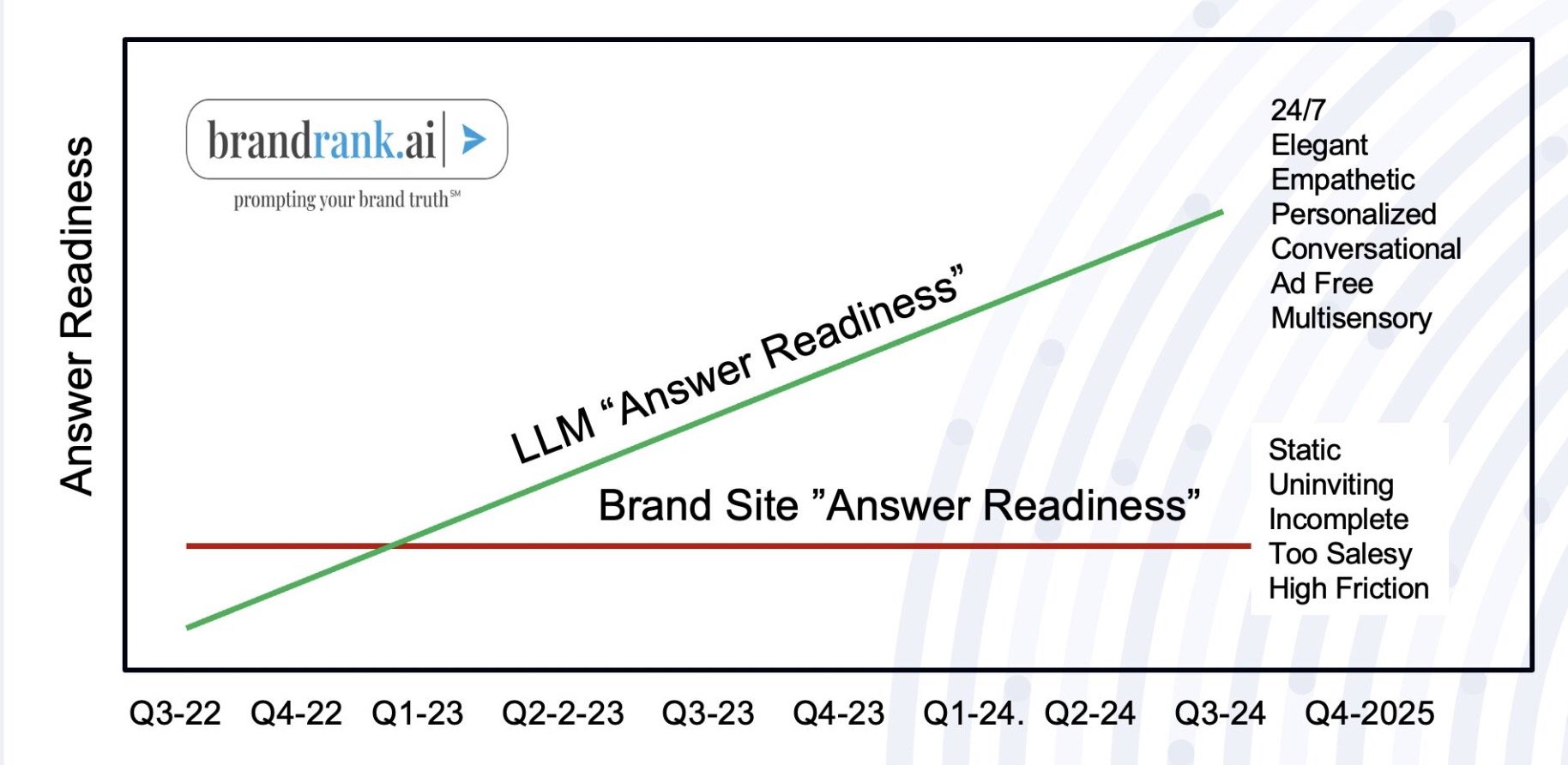
They were built to persuade. AI systems need pages that explain, prove, compare, and answer.
The gap between AI answers and B2B website content is widening.
That is the shift this article explains.
Traditional SEO asks: Can this page rank? AI search optimization asks: Can this page become the answer buyers trust?
AI visibility now means citations and clicks
In traditional SEO, visibility was easier to measure. You tracked rankings, impressions, clicks, and conversions.
AI search adds new visibility signals. Your brand may be mentioned in an answer, cited as a source, included in a comparison, or used to shape a buyer shortlist before the buyer clicks anywhere.
For example, when ChatGPT answers a question like “What are the best project management tools?” it may mention Asana, Monday.com, and Notion directly in the response. The buyer gets a shortlist without visiting any website.
That does not mean clicks no longer matter. It means the buyer journey may start inside the AI answer, then continue through branded search, direct traffic, paid search, review sites, or a sales conversation.
Traditional SEO asks: Where do we rank, and how many clicks did we get?
AI search optimization asks: Are we being mentioned, cited, compared, and clicked from AI-powered discovery journeys?
The new measurement question is not only whether AI sends traffic. It is whether AI mentions your brand, cites your content, and helps move buyers toward your site or sales team.
If your content is hard to parse, buried in fluff, or scattered across PDFs and long pages, it is less likely to be surfaced. That holds true even in real-time tools.
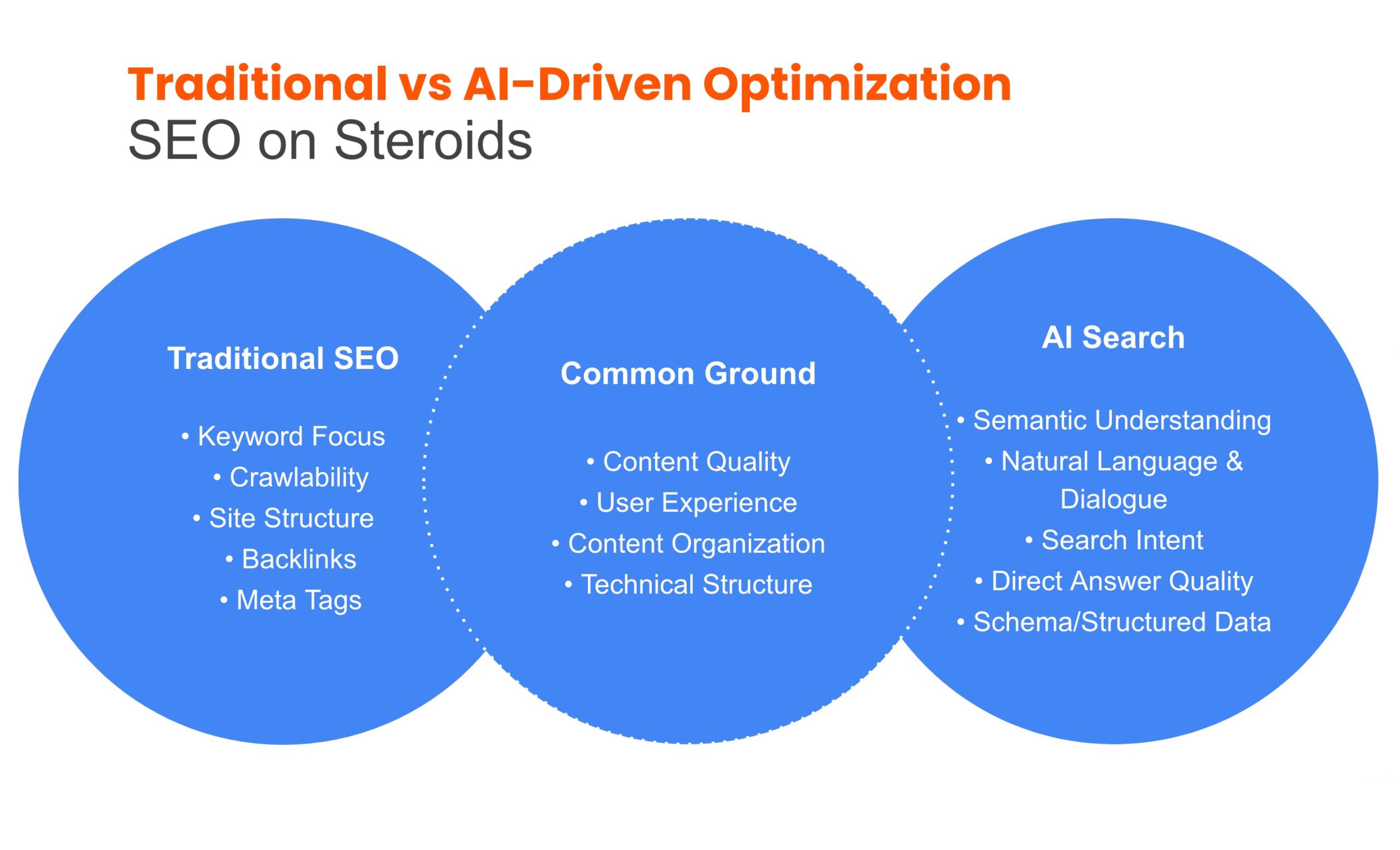
SEO and AI search overlap. Each also has its own demands.
Not all AI tools rely only on training data. Some can retrieve fresh information from the web at runtime. This includes Google AI Overviews and AI Mode, Microsoft Copilot, Perplexity, and ChatGPT and Claude with browsing turned on.
That means they aren’t just responding based on what they were trained on months ago. They’re also pulling from live sources like public websites, news articles, help docs, and product pages.
But even then, these tools don’t crawl the internet like a search engine. They rely on pre-indexed or structured content, and they prefer sources that are clear, scannable, and trustworthy.
Clarity and structure now matter more than raw word counts. Start with a summary, Large Language Models (LLMs) use it to identify context early.
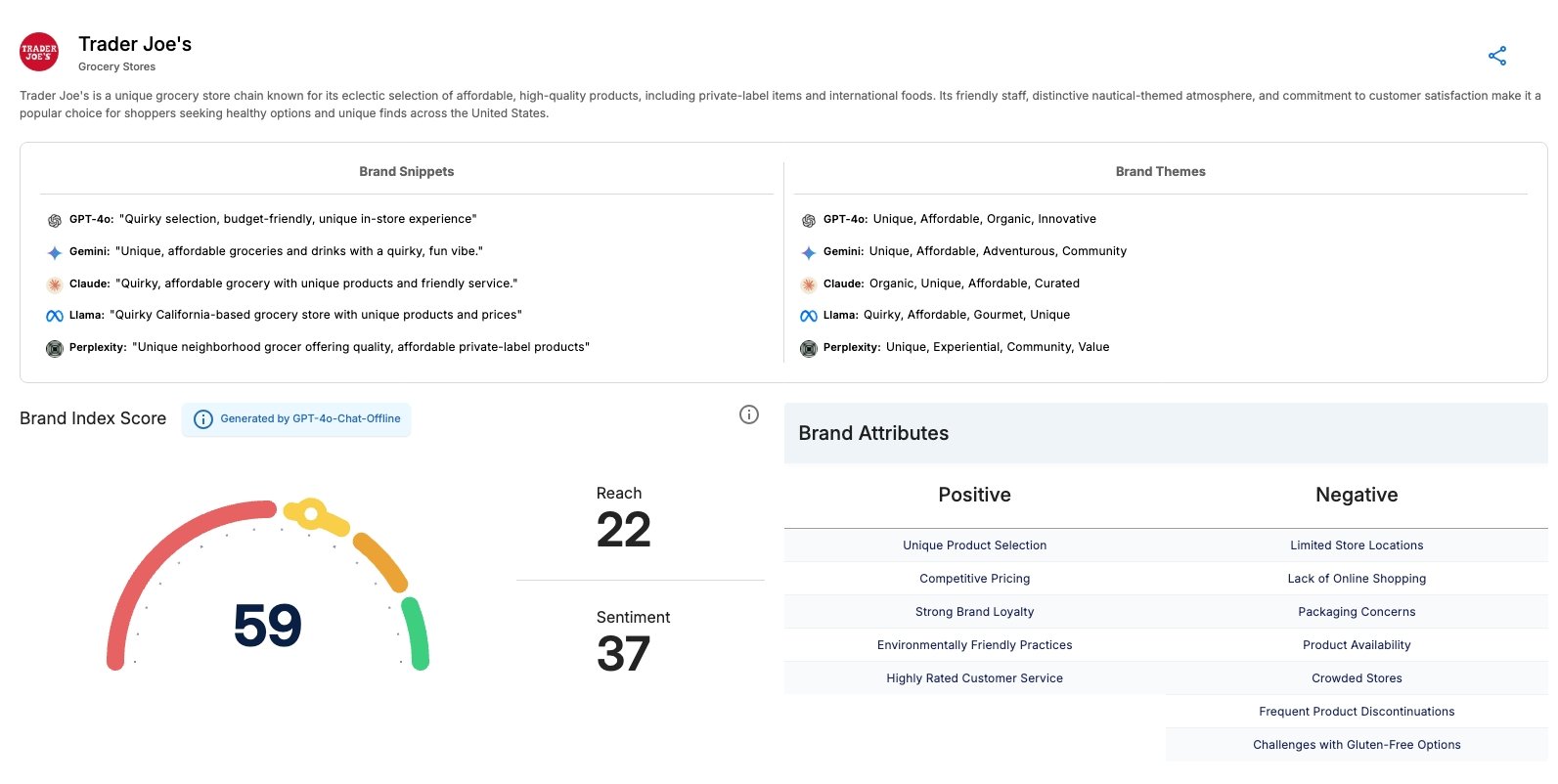
AI Brand Management Score
This snapshot from Revere represents a small but valuable example of the types of brand insights that AI-powered brand management platforms can generate — including sentiment scores, brand perception summaries, and competitive positioning data.
What is the best way to show up? Make your content clean, structured, and easy for machines to understand.
That’s why well-organized content often gets surfaced, while long, unstructured pages get overlooked.
Here’s the upside: many traditional SEO best practices still apply.
Use clear headers.
Write in short paragraphs.
Keep a logical structure.
All of that still improves visibility — just for a different kind of system. In practice, LLMs generally absorb content found in:
Wikipedia entries
Blog post intros
News story summaries
Product feeds
FAQs and comparison tables
Webinar transcripts and recap posts
AI systems favor content that’s easy to scan, not buried in dense walls of copy.
Why might that be? Simple. There’s no structure to a block of text.
In traditional SEO, authority came from backlinks, domain age, and ranking signals.
You built it over time, mostly through your website.
Generative AI changed that.
What matters now is “entity authority.” It is whether your brand shows up consistently across trusted sources online.
I’ve seen companies pour resources into their websites while ignoring everything else.
But AI learns from all of it: product listings, news mentions, schema markup, customer reviews. Each one teaches the model who you are. Your website does not have to rank first for AI to trust your brand.
Take one mid-sized brand we worked with.
They improved their visibility in AI-generated answers by leaning into strategic PR, not more blog posts.
They published a series of thought leadership pieces, partner announcements, and product launches. Outlets like Business Wire, TechCrunch, and niche industry sites picked them up.
Because that content was well-structured, widely syndicated, and published on authoritative domains, it gave the AI multiple touchpoints to associate the brand with key topics.
A few weeks later, their name started showing up in chatbot summaries and AI Overviews. Not just from their own site, but from quotes pulled directly from third-party coverage.
It’s no longer just about your website.
It’s about your entire digital footprint. Everywhere your brand can be seen, named, structured, and understood.
Think Like a User, Not an Algorithm
LLMs don’t care about keyword stuffing.
They’re trained to understand what people are actually asking.
Content that answers real questions, in natural language, performs better.
Instead of writing “POS software,” ask: “What’s the best POS system for a small retail store?”
That’s how users think.
And that’s how AI models evaluate relevance.
LLMs Interpret Intent, Not Just Keywords
In an AI-first world, traditional keyword research isn’t the starting point. Understanding your audience is.
Instead of chasing individual keywords, we:
Start with audience questions or pain points
Use ChatGPT to map topic clusters and buyer journey
Build a content model that addresses the full set of buyer needs
Track visibility in AI results, traffic quality, and content engagement
It’s not about who wrote the content or keywords. It’s about whether it’s useful.
Client Result: A GEO Rewrite That Got Cited
We rewrote a 2,000-word article using generative engine optimization best practices: tighter structure, clearer takeaways, improved headings and subheadings, a more conversational tone, and a clean, structured schema.
Within weeks, it was showing up in Google’s AI-generated summaries, complete with a direct link to the article.
You’re Now Optimizing for More Than Just Search
It’s not just about Google anymore.
Your content is now being used in AI-powered tools that serve answers directly to users, including:
Public-facing chatbots
Voice assistants
Generative search experiences like Google AI Overviews and AI Mode
In-product assistants like Microsoft Copilot and Google Gemini
Each of these tools surfaces content differently.
Chatbots want clear product specs.
Voice tools need short, conversational answers.
AI search favors comparison tables and structured FAQs.
Copilot and Gemini work best with well-structured, scannable guides, especially when they pull from public knowledge sources.
Note: These tools don’t access private content. They surface what’s public: blog posts, FAQs, reviews, and structured data.
To show up, your content needs to be built for more than search engines. It needs to be AI-ready — wherever users ask, not just where they search.
AI-Generated Content Is Not Penalized
Google prioritizes quality and usefulness, regardless of whether content is written by a human or AI. AI-generated content isn’t penalized. But low-quality content, whether produced by AI or humans, is unlikely to perform well in search.
The goal remains to deliver helpful, original, and relevant content.
Also worth noting: Google updated its guidance for human content raters. Raters are asked to evaluate AI-written content, but they were not given tools to detect it.
Take Action: Be AI-Ready
The shift from traditional SEO to AI-ready content isn’t coming. It’s already here. Companies adapting their content for AI visibility are gaining ground. Those clinging to outdated SEO tactics are increasingly missing from the conversation.
The question isn’t whether AI will change how people find your business. It’s whether you’ll be ready when they ask the questions only your brand can answer.
Yes, many companies are seeing organic traffic flatten or decline.
ToTheWeb's own site lost 100K organic visitors YoY after multiple years of double digit growth.
Apple confirms first-ever decline in Google searches. For the first time in its 22-year history, Safari users are increasingly turning to AI tools like ChatGPT and Perplexity instead of Google.
During the U.S. Department of Justice's antitrust trial against Google in May 2025, Apple's SVP of Services Eddy Cue testified under oath that April 2025 marked the first recorded drop in Google search activity via Safari since the browser's launch. Source: The Verge, April 2025
Not necessarily. Start by identifying your highest-impact pages, the ones most likely to answer real customer questions or support discovery in AI tools.
Then apply LLM optimization techniques: restructure for clarity, add FAQs, summarize key points, and use schema markup. In many cases, small formatting improvements go a long way.
Tools like Revere.ai can monitor citations across platforms like ChatGPT, Gemini, Perplexity, and Google AI Overviews.
You can also manually test prompts, analyze AI summaries, and track referral patterns. Visibility in LLMs is still an emerging metric, but it’s measurable and actionable.
We use Revere's Luminaire to monitor brand presence, and Google Analytics to measure inbound traffic and conversions from AI tools like ChatGPT, Gemini, Perplexity, and Claude.
You may stop being part of the conversation and be excluded from buyer shortlists.
AI-generated answers are becoming the first touchpoint for product research, vendor comparisons, and customer decision-making. If your brand isn’t included, your competitors will be.
The longer you wait to optimize, the harder it becomes to reclaim visibility in AI ecosystems already training on others.