
Back to Expert Advice
What happens when your first visitor is a machine?
AI systems scan and summarize your content before any human does. If AI can’t find your content, you’re not in the conversation.
That’s what’s behind a new discipline called Generative Engine Optimization (GEO). GEO is the process of preparing your content to be accurately understood and summarized by AI platforms.
This roadmap shows CMOs exactly where to start so AI gets your brand right.
B2B buyers decide earlier than most teams realize. Forty-one percent start with a vendor already in mind.
Forrester, “Why Performance Marketing Falls Short,” June 24, 2025
Four Phases to Strengthen your AI Signal
Search Traffic is Collapsing
- Organic CTR drops by 61%.
- Paid CTR drops by 68%.
- Total Clicks fall from ~15% to 8%.
- 96.55% of web pages get 0 traffic from Google.
The Reality: Zero-click behavior is rising sharply. If you are not cited in the AI answer, you are not getting the visit.
Sources: Forbes | Pew Research | aHrefs
THE AI-FIRST ROADMAP
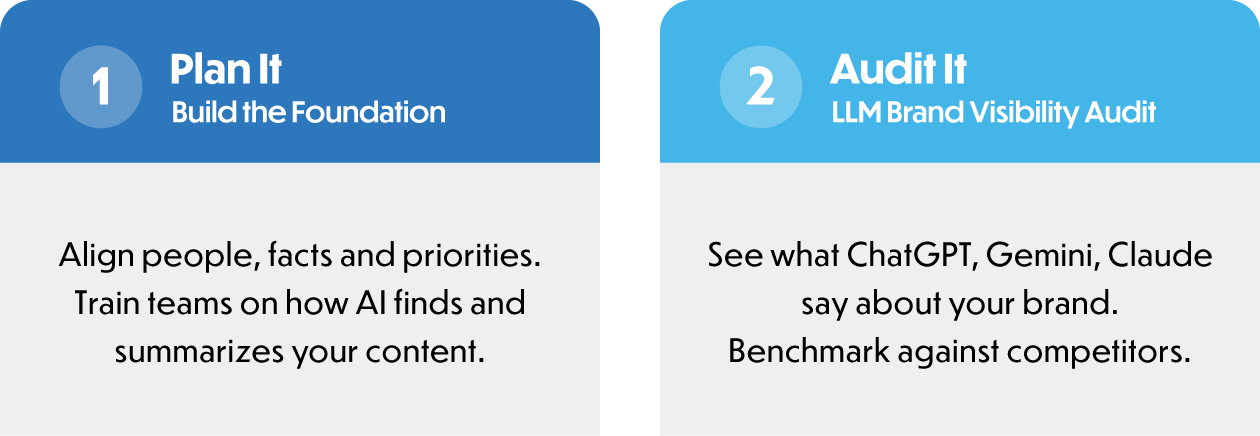
1. Plan it → Build the foundation.
Teams cannot produce AI-ready content without a shared view of what your brand must be known for or which buyer questions matter most.
GenAI is no longer a pilot. Your teams already use it, but not with the same level of skill or confidence.
CMOs set the foundation by defining five things:
- What your brand must be known for
- Which buyer questions drive your category
- Which facts and claims AI must get right
- Who owns which messages
- One shared Brand Messaging Guidelines document
► Get your team aligned before you move to the next phase.
2. Run an LLM Brand Visibility Audit
A Brand Visibility Audit shows you:
- A list of the buyer-relevant questions AI currently associates with your brand, along with the sources it uses to answer them.
- Which buyer questions matter most and where clearer answers are needed on your site.
These insights give you what you need to build a site-wide FAQ page (example) that answers the highest-value buyer questions AI is already being asked.
By organizing those questions across key personas and buying stages, you create a content structure that supports how real buyers make decisions.
► Start here: Run an LLM Brand Visibility Audit to see how AI describes your brand today.
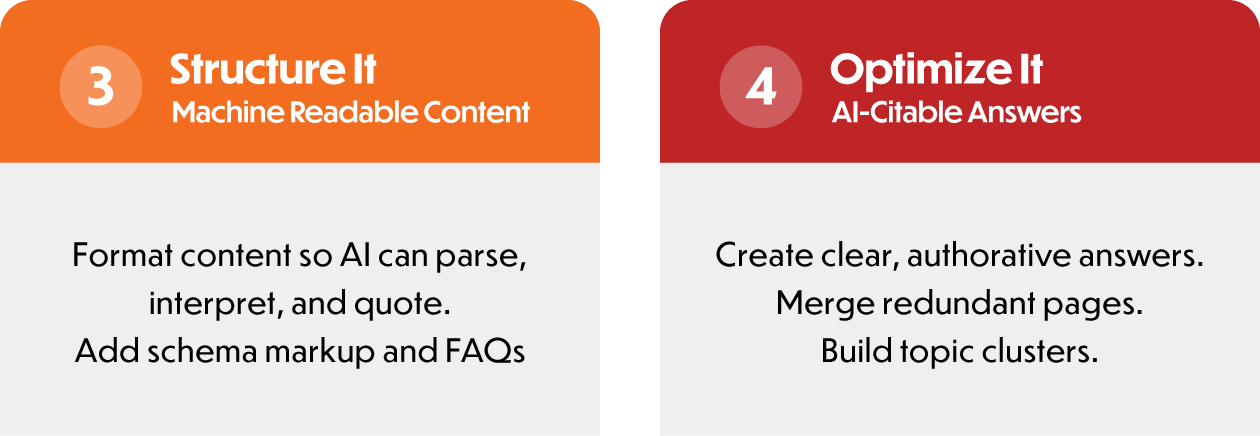
3. Structure it. Give AI one clear version of your story.
Overlapping pages, mixed terminology, and conflicting claims confuse AI. When that happens, buyers find a competitor with a cleaner story.
The ongoing rule is simple: check before you create.
Improve the page that already covers the topic instead of publishing a new one.
- Review existing pages for duplication, outdated claims, or conflicting explanations.
- Keep terminology, facts, and messaging aligned with your Brand Messaging Guidelines.
- Maintain clear internal links so both AI and buyers reach your strongest pages quickly.
Do this once, maintain it consistently, and you stop losing ground to competitors with cleaner signals.
► Fix the clutter Start with an AI-Enhanced Content Audit.
4. Scale It. Make Visibility a Habit.
Commit to one clear, authoritative answer for every core buyer question, then back it with facts your team can defend.
Our Content Audit CustomGPT can review drafts for clarity and structure before publishing, so every new piece of content reinforces, not weakens, your AI visibility.
This is how you stay visible as AI keeps changing the rules.
Executive Summary: 90-Day Starter Plan
Here’s how the four phases map to your first 90 days and what to actually do each month.

Month One establishes your AI baseline by auditing current visibility, tracking AI-driven traffic, and surfacing your top buyer questions.
- Run the LLM Brand Visibility Audit to see how AI describes your company today.
- Set up GA4 AI tracking to monitor assistant-driven traffic from AI assistants.
- Identify the top 10 buyer questions LLMs surface across platforms.

Month Two focuses on aligning AI messaging so every team, page, and third-party profile tells the same clear story.
- Draft AI Brand Messaging Guidelines so every team uses the same voice, terms, and proof points. Reference it whenever you use an AI assistant.
- Publish sitewide FAQs on priority pages to answer top buyer questions.
- Align terminology and claims across existing pages.
- Audit third-party sources such as ZoomInfo, Crunchbase and Wikipedia, and correct outdated or inaccurate information that shapes AI summaries.

In month three, focus on making your best answers easy for both AI systems and buyers to find, understand, and reuse.
- Put the most important answers on high-visibility pages: About, Product, Solutions, Industry.
- Make key answers visible on primary pages, not buried in PDFs or low-authority locations.
- Ensure answers live in HTML so AI systems can parse them.
- Link these pages from navigation or other high-authority pages to improve reachability.
- Consolidate scattered answers into strong, central pages that own the topic.
What happens when you follow this roadmap?
- You give AI one clear, consistent story to learn, cite, and share.
- Your answers surface earlier, your claims stay accurate, and your brand appears in more AI-driven conversations.
- You build something that holds up as AI keeps changing. Your competitors have to start over. You don’t.
How This 90-Day AI Plan Works
FAQs
Why does AI visibility matter?
AI systems scan, extract, and summarize your content before buyers ever reach your site.
AI visibility matters because if AI cannot find or interpret your answers, your brand disappears from buyer shortlists.
Zero-click behavior is rising sharply, and 96% of pages get no Google traffic.
Your content must be easy for AI to read, cite, and use for buyer questions.
LLM audit versus content audit: what’s the difference?
The LLM Brand Visibility Audit shows how AI platforms describe your brand today.
It identifies the top questions models surface, the sources they rely on, and gaps or inconsistencies in how answers appear across tools. See details about this audit.
The Content Audit examines your website structure and pages.
It identifies duplication, outdated messaging, off-brand content, and competing versions of the same answer.
Together, the two audits give you a full picture: how AI sees you and how your site structure may be helping or hurting that visibility. See details about the content audit.
What is the first step toward improving AI visibility?
Start by aligning your people, priorities, and facts.
Your marketing team needs a shared view of what your brand must be known for and which buyer questions matter most.
An AI Brand Messaging Guidelines ensure every AI-assisted draft reflects the same story.
It requires completion of the LLM Brand Visibility Audit to be most effective. It contains:
- <1,000-word, model-friendly messaging spec (voice/tone do's-don’ts, approved terms, banned claims)
- Proof policy (metric + source + date + URL)
- Answer-first standards (75–120 words) + schema preferences (FAQ/HowTo)
- CTA rules with examples
How it’s used: Referenced as the source of truth; writers and AI read it first before drafting content.
How should we structure our website for AI systems?
Structure your site as a set of clear, question-based pages that AI can find, understand, and quote.
- Give each major buyer question one primary “home” page.
- Use one clear name for each concept, and keep that same name in your headings so AI does not misinterpret or split the topic.
- Consolidate overlapping pages so each buyer question has one primary page, not fragmented answers across multiple URLs.
- Put the direct answer in the first 75 to 120 words, then add proof, steps, and FAQs.
How do we keep our visibility strong as AI evolves?
Treat AI visibility as a continuous process, not a one-time project.
- Improve existing pages before creating new ones.
- Regularly review pages for duplication, outdated claims, or missing answers.
- Maintain clear internal links so AI and buyers reach your highest-value pages first.
What results should a CMO expect from the 90-day roadmap?
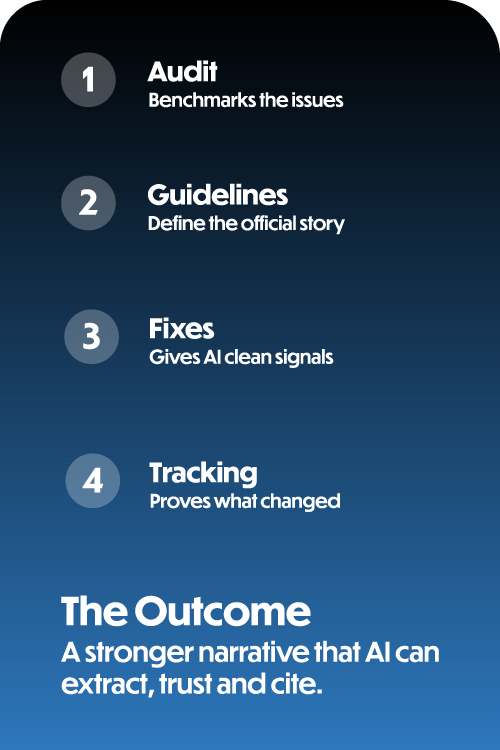
In 90 days, you should see a measurable improvement in how AI systems find, describe, and recommend your brand to buyers.
- You get a baseline of how AI sees your brand today.
- Your teams gain shared language, consistent messaging, and prioritized answers.
- Your most important content becomes easier for AI to read, extract, and cite.
- This creates a stronger narrative that improves visibility in AI-generated decisions.
- As you apply these practices, you should start to see more inbound traffic and inquiries from LLMs.
- Your teams gain shared language, consistent messaging, and prioritized answers.
- Your most important content becomes easier for AI to read, extract, and cite.
This creates a stronger narrative that improves visibility in AI-generated decisions.
As you apply these practices, you should start to see more inbound traffic and inquiries from LLMs.

Rosemary Brisco

AI Training Videos
AI Visibility & Workflow Training
Make your brand easy for LLMs to find and quote.
Teach your marketers practical AI workflows that save hours and lift results.
Start by Training your Marketing Team