
Back to Expert Advice

Your website is the last place your buyer looks now.
By the time they land on your homepage, they have already asked AI for a shortlist, checked peer reviews, and formed an opinion. You are not the start of the research. You are the confirmation step.
92% of buyers already have a shortlist before they begin formal research. Forrester, 2024
You won’t see it in Google Analytics—but AI agents are becoming your most important visitors.
Buyers are asking ChatGPT for vendor recommendations instead of googling “best CRM software.” They are getting instant answers instead of downloading your gated white papers.
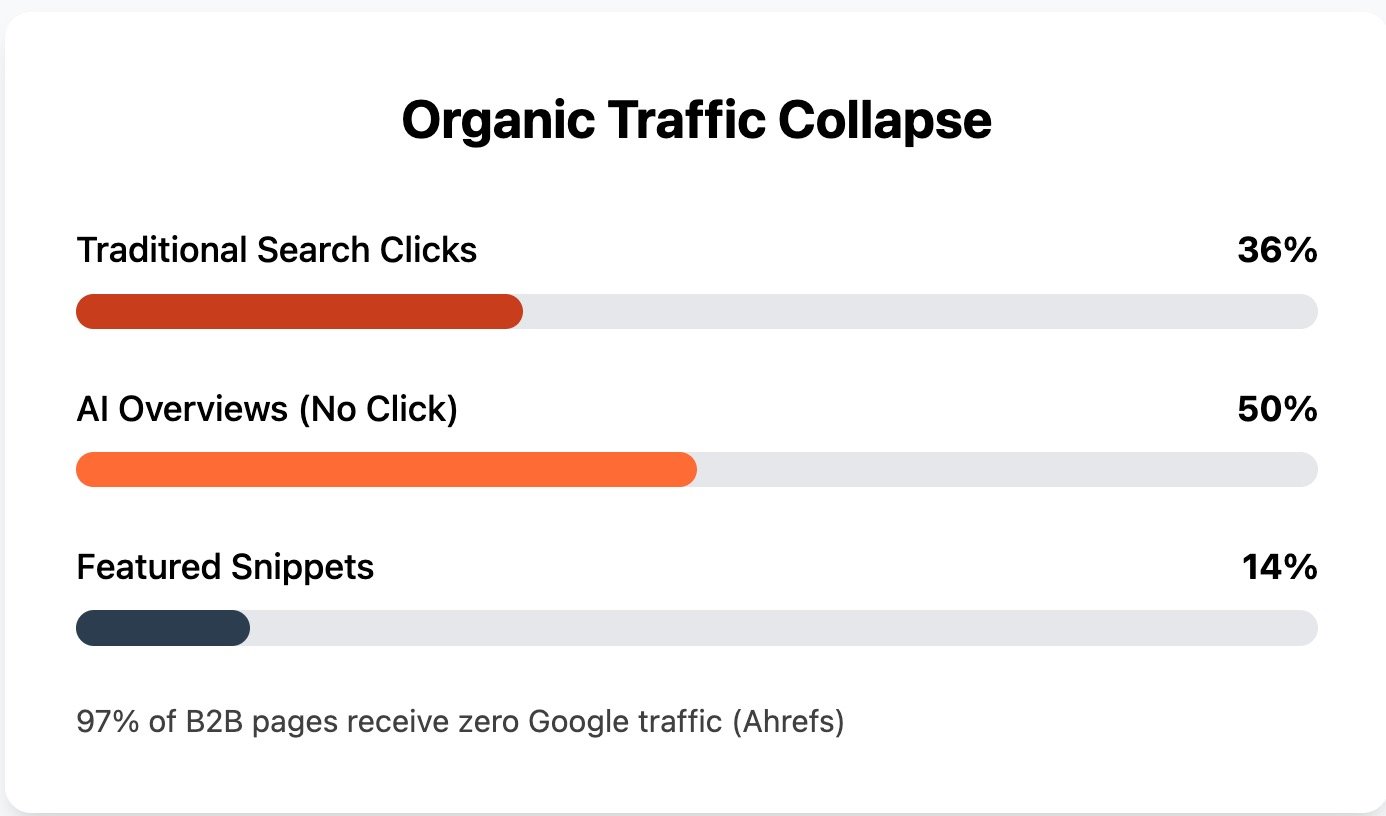
Forbes | Pew Research | aHrefs
Organic traffic? Don’t count on it. AI Overviews now appear in 42% of Google searches, cutting organic click-through rates from 1.41% to 0.64% when they show. Paid clicks are down too—even when no AI Overview appears.Search Engine Land: CTRs Hit New Lows
This is not theoretical for us.
After years of double-digit YoY growth, ToTheWeb lost 100,000 organic visitors in the past year. The traffic did not go to a competitor. It went to AI. Replacing that traffic with paid ads would cost us an estimated $500,000.
Key Takeaways
- The buyer already has a favorite—before they ever talk to you. 41% of B2B buyers have a single preferred vendor in mind before formal evaluation even begins. The buying journey is now confirmation, not selection. Forrester Research
- Agents read your site before any human does. . Your website’s first job now is to hand them clean, structured data they can quote correctly.
- The decision happens in a funnel you can’t see. Up to 70% of searches now end without a click, and 77.5% of B2B buyers share content through private “dark social” channels. By the time a prospect contacts sales, the evaluation is over—so the only winning move is to build authority across the entire digital ecosystem, not just your own site. Zero-Click Searches | Cognism
There are two kinds of AI agents changing how buyers find you.
First are assistive agents you can build today—CustomGPTs and Google Gems. They turn hundreds of pages into a side-by-side vendor comparison in minutes. Your buyers are already using these to evaluate you.
Your Move: See how you stack up the same way your buyers do. We built a CustomGPT for competitor research—drop in a few URLs and it shows you the comparison your buyers are already running.
Then come fully autonomous agents. Banks already use them to track contract renewals, renegotiate terms, and execute agreements—cutting renewal cycles by 75%. Agentic AI for Banking Contract Renewals
Your Move: Make sure your pricing, specs, and terms exist as structured, machine-readable data—these agents act on what they can parse, not what they can interpret.
Both kinds of agent build their picture of you from data you may not control. Your job is to make that data accurate, structured, and everywhere they look.
The “AI-first” generation now controls the buying decision.
Here’s why this shift is permanent, not a phase: the people doing the buying changed. Millennials and Gen Z grew up with Google, and now they have AI in their pocket. They expect to research, compare, and decide on their own—and they do.
Millennials now make up 73% of all B2B buyers. They’ve made self-service the default: 68% prefer researching on their own over talking to a person, and 90% read peer reviews before they buy.
Forrester: Millennial Buyers | AmplifAI | PowerReviews
By the time they’re willing to talk to your sales team, the real evaluation is already finished.
Your move: Make your strongest proof—pricing logic, comparisons, real outcomes—available without a form or a sales call. This buyer decides before they ever raise their hand, so the information has to reach them while they’re still researching alone.
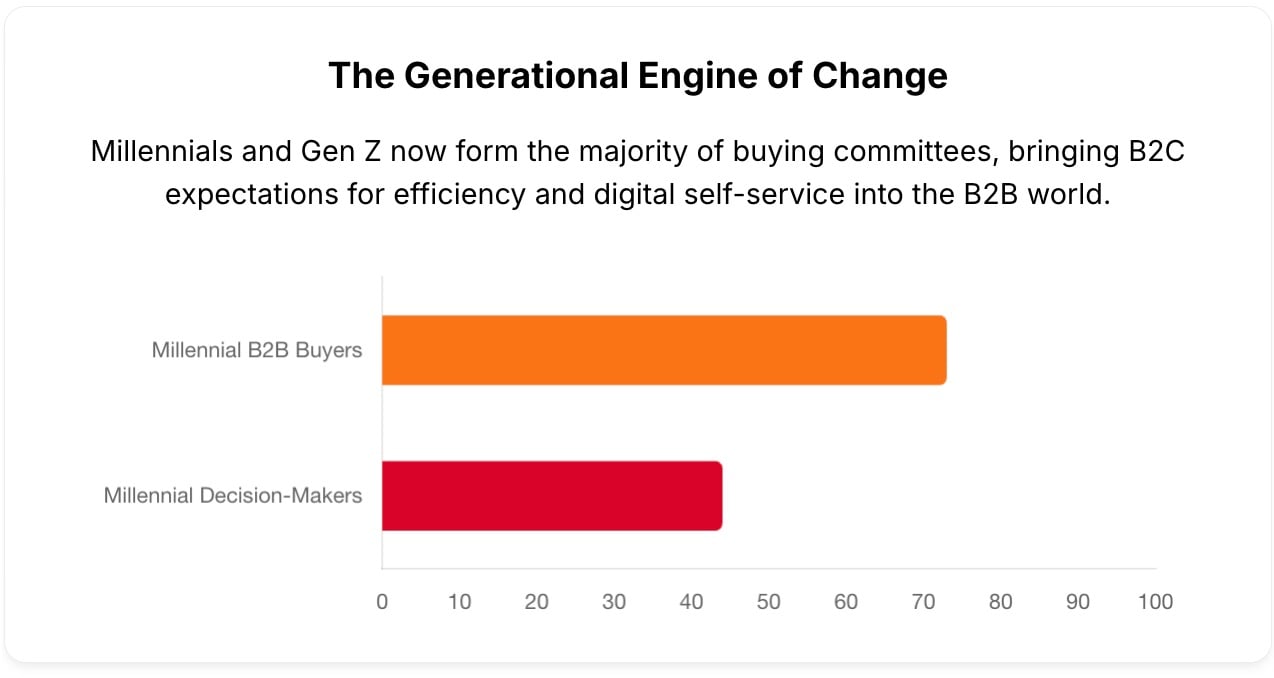
Younger Generations Are Shaking Up B2B Buying
But here’s what’s really different: your youngest buyers don’t just use AI to research—they trust what it tells them. And that trust is generational, which means it only grows from here.
Gen Z buyers are 50% more likely than older generations to trust AI-generated content: 30% trust it “always” or “very often,” versus 20% of their elders. More telling for how they actually behave—61% of Gen Z and 53% of Millennials now reach for AI tools instead of Google when they research.
AMPLYFI | Marketing4eCommerce | Digital Information World
For these buyers, the AI’s answer about you isn’t a secondary impression they’ll double-check on your site. It is the impression.
Your move: Treat AI answers as your front line, not your back-up. The facts an AI can find and trust about you—clear claims, real data, third-party validation—now matter more than the polish of your homepage, because a growing share of buyers will never compare the two.
AI is the new interface between you and your buyer.
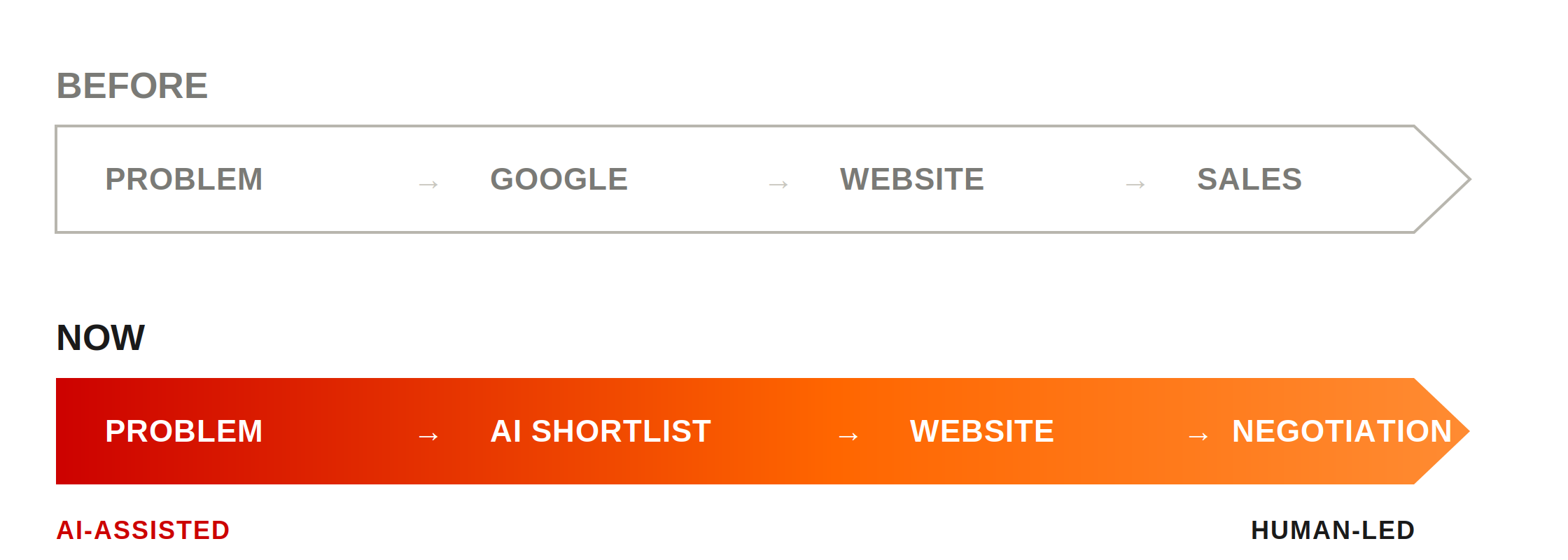
Here’s the change in one line: the buyer used to start at Google and finish with your sales rep. Now they start with an AI—and only reach you at the end, if your name made the AI’s shortlist.
The buyer’s journey, before and after AI:
The traditional path
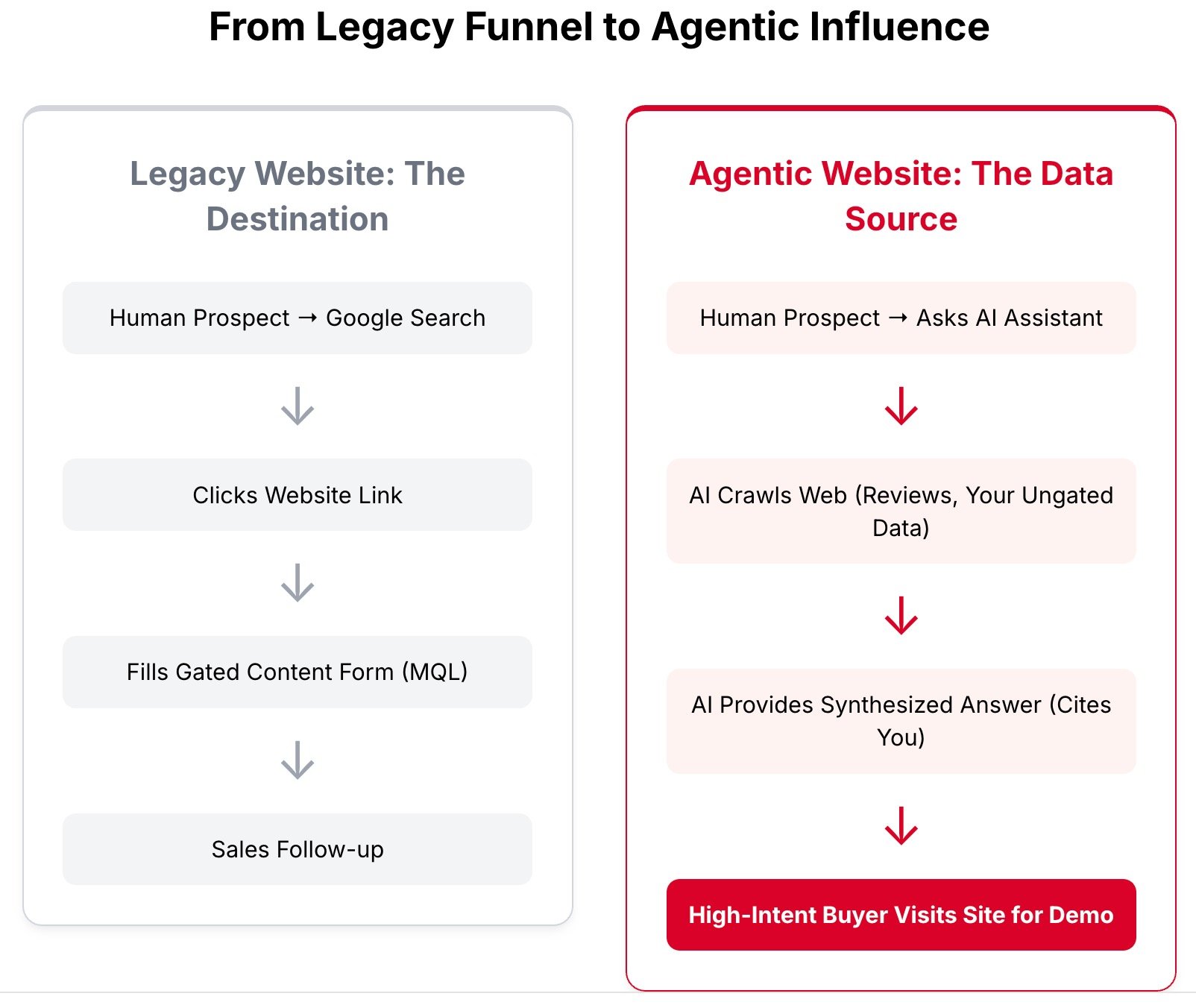
Google Search → Vendor Websites → Whitepaper / Download → Sales Rep Interaction
The AI-driven path
Prompt to AI → AI-Generated Summary & Comparison → Vendor Shortlist → Late-Stage Sales Interaction
Look at where you enter each path. In the old one, your website did the persuading. In the new one, the AI has already summarized, compared, and shortlisted—before you even know the buyer exists. If you’re not in that summary, you’re not in the deal.
Your move: Write so an AI can lift your answer cleanly—lead with the claim, back it with a number, name the outcome. The goal isn’t to rank on a results page anymore. It’s to be the vendor the AI names when it builds the shortlist.Full details in the GEO Checklist
Gated content? A strategy past its expiration date.
Lead magnets are dead. Gating works against you twice. First, AI can’t get past the form at all. An LLM won’t fill out fields, so your gated content is simply invisible to it. It can’t cite what it can’t reach.
Second, even your ungated PDFs parse poorly. LLMs struggle to read them—the data isn’t structured, so extraction comes out patchy and unreliable. Your best proof gets garbled or skipped.
And the human side? When prospects can ask ChatGPT a question and get a full answer in 30 seconds, few will trade their email for a form.
Your competitors who embrace transparency will appear in AI answers. You won’t.
What if your most influential content never shows up?
77.5% of B2B buyers share content through dark social channels—email, messaging apps, private communities. Your attribution models can’t track this activity, which means you’re flying blind on what actually influences decisions.2025 Marketing To Tech
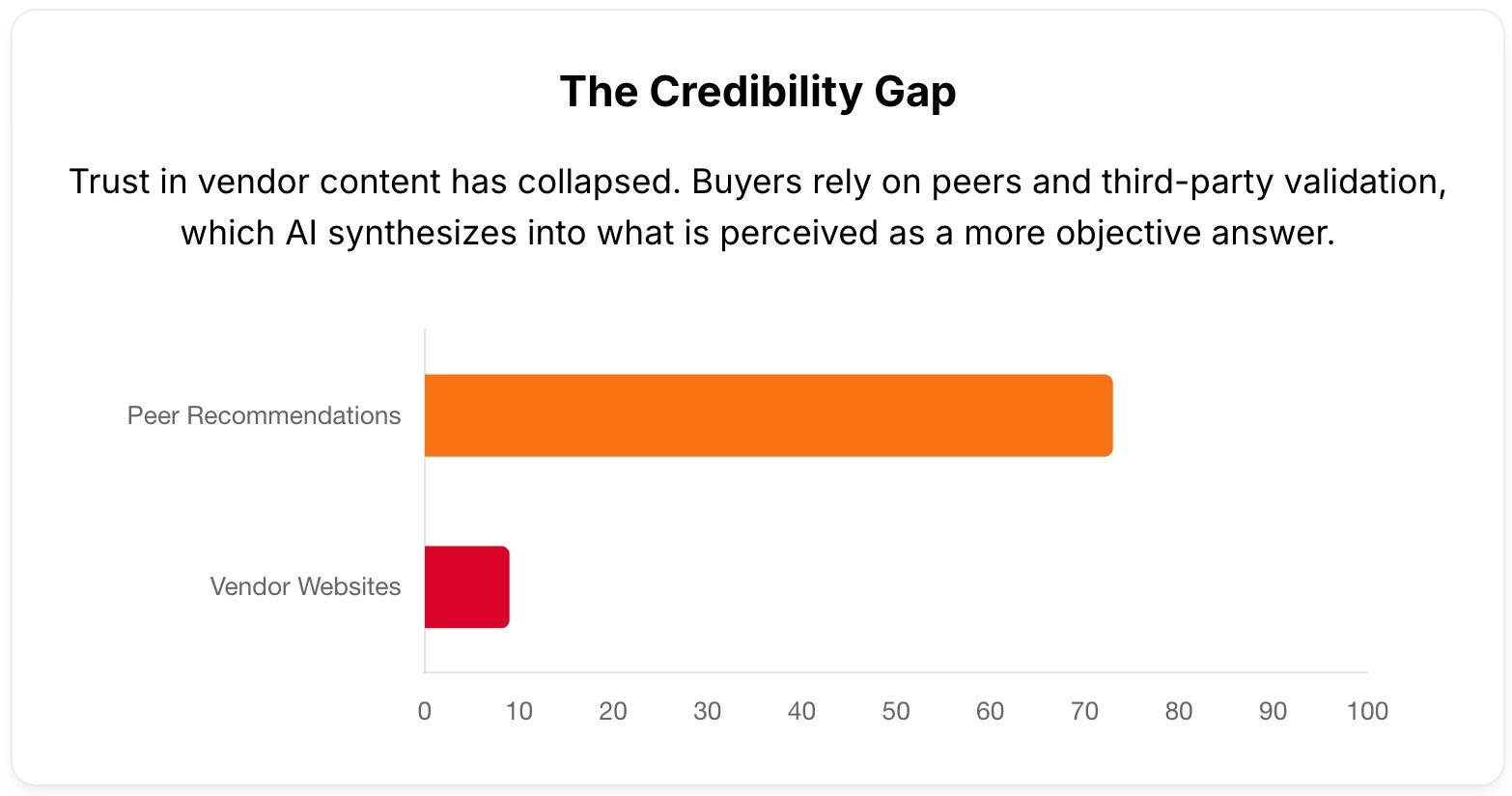
The credibility crisis.
Here’s an uncomfortable reality: your prospects no longer hear your message in your voice.
They encounter your company through AI summaries that strip away your positioning and reduce you to bullet points alongside competitors. And they act on those summaries—even when they don’t fully trust them.
- Only 24% of people trust AI-generated information completely.UPI
- Yet 47% of enterprise AI users have made major decisions based on potentially inaccurate AI content.Economic Impact of AI Content
That’s the trap: buyers research you through AI, don’t fully trust what it says, and head to third-party platforms to verify before they ever book a demo. Trust isn’t built on your homepage—it’s earned where your buyers already are.Marketing Profs
Your website is now a data mine, not a sales funnel.
Here’s the shift: your website now has two audiences—the humans who read it, and the AI agents who parse it. And the agents go first. They read your site, extract what they can understand, and summarize you to the buyer before a person ever lands on the page.
Here’s what “structured data” actually means.
Structured data is machine-readable labeling for important page facts. Instead of relying only on visible text like “Starting at $499/month,” schema markup can identify the page as a product or service offer and specify fields like price and currency. That helps search engines and AI systems interpret your pricing more accurately. It does not guarantee inclusion or prevent mistakes, but it reduces ambiguity and can improve eligibility for richer search features.
Your move: Start with three schema types—Organization, Product, and FAQPage. They tell the AI who you are, what you sell, and the questions buyers ask. Our GEO checklist walks through each one.
From legacy funnels to agentic influence: evolving the marketing journey
When the buyer finally arrives, AI is your front door.
Here’s how this connects to everything above: the buyer who reaches your site now shows up late and already informed. They don’t want a brochure—they want a specific answer, fast. That’s the job conversational AI does well.
Modern AI assistants handle complex B2B questions, not just “what are your hours.” A good one can qualify a late-stage buyer and surface the right proof in the exact moment that buyer is paying attention.
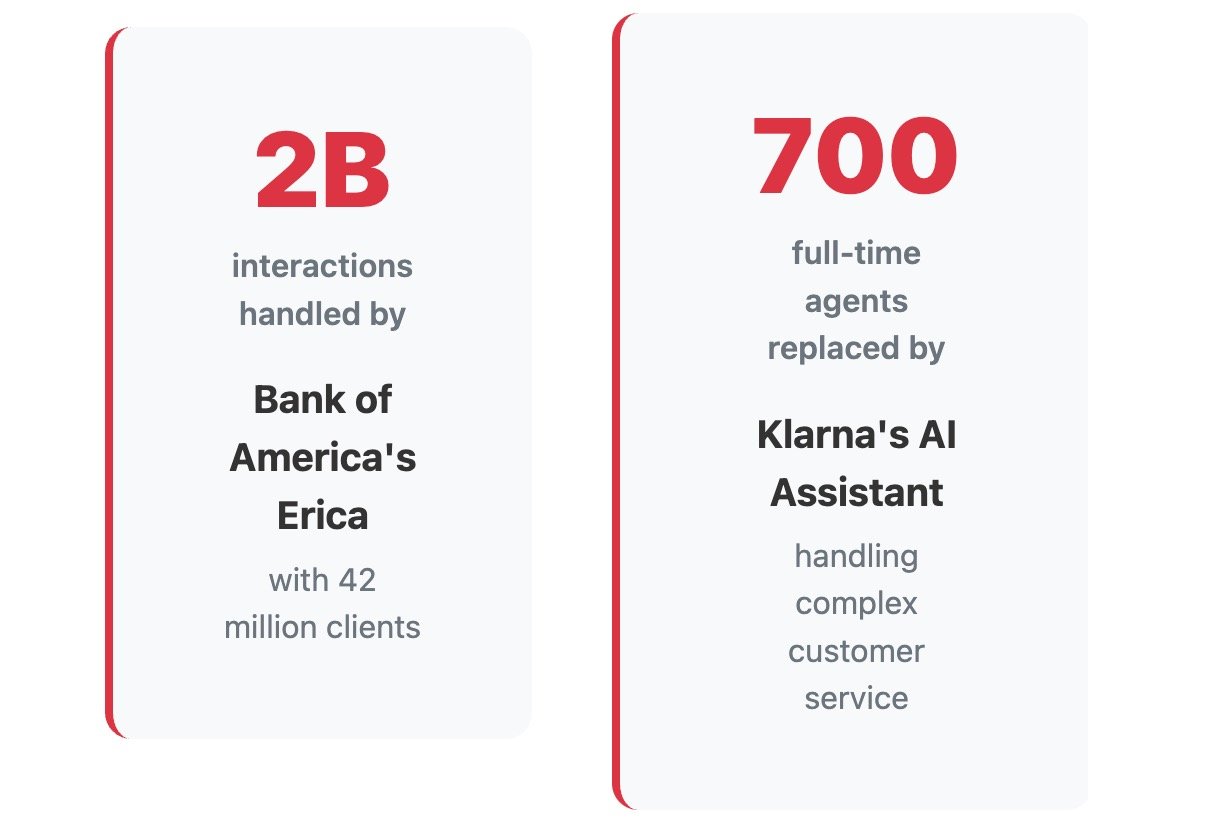
This is proven at scale. Bank of America’s Erica has passed 2 billion customer interactions; Klarna’s AI assistant handles two-thirds of its service chats. The technology is ready for serious B2B use.Bank of America | Klarna
Your move: Write down the three questions your AI should answer on its own, and the one moment it should pull in a salesperson. That single rule—where AI stops and a human starts—is the whole game.
AI barely cites your website. It cites everyone else’s.
Here’s the most important number in this whole post: for B2B queries, your own website makes up as little as 3–17% of the sources AI cites. Independent platforms make up 60–70%.Search Engine Land: 8,000 AI Citations
When an AI builds its answer about you, it leans on Wikipedia, G2, Gartner, PCMag, and major news outlets—not your homepage. It fact-checks you against third-party sources, and it trusts Wikipedia’s neutral tone more than your marketing copy. The story it tells about you is assembled from places you don’t own.
Your move: Stop pouring everything into your own site and start earning presence where AI actually looks. Get listed and reviewed on G2 and Gartner, pursue credible press, and keep your Wikipedia presence accurate. Those third-party mentions now shape your reputation more than your homepage does. Here’s how Wikipedia fits in.
The next wave isn’t AI helping buyers—it’s AI doing the buying.
Here’s where this is heading: AI won’t just research vendors for your buyer. It will transact on their behalf. Gartner projects agentic AI will autonomously resolve 80% of common customer service issues by 2029, and McKinsey expects AI to handle 60% of B2B seller work by 2028.
Procurement systems are already moving toward executing routine purchases with little human oversight. When that becomes normal, the buyer isn’t a person reading your page—it’s an agent querying your data. A website built for human eyes won’t even be in the running.
Your move: Start making your core facts—pricing, specs, availability—machine-readable now, through structured data and clean, queryable pages. The companies an AI agent can transact with easily will win the deal before a human is ever in the room.
What should your new revenue dashboard track?
If the funnel changed, the scoreboard has to change too. The metrics that measured the old buyer journey—clicks, form fills, rankings—can’t see the new one. Here’s what to track instead.
| DEPRECATE ↓ | ADOPT ↑ | Strategic Value |
|---|---|---|
| MQLs / Lead Volume | High-Quality Inbound Inquiries | Measures actual buying intent, not content downloads. |
| Organic Website Traffic | Branded Search Volume | Indicates brand recall built in the dark funnel. A direct measure of mindshare. |
| Keyword Rankings | Share of AI Citation | Measures influence where buyers get answers. The new “ranking #1.” |
| Form Conversion Rate | Interactive Tool Engagement | Identifies prospects actively “kicking the tires” in late-stage evaluation. |
| Click-Through Rates | AI Agent Interactions | Tracks how effectively AI systems parse and utilize your content for recommendations. |
Your 12-Month Action Plan
Companies have 12–18 months to make their content findable, quotable, and trusted before competitors become the default AI-recommended options.
Competing in the Agentic Web takes a deliberate plan. The next 12 months break into three phases—Foundation, Integration, and Scale—each building on the last. Start with the GEO checklist.
Phase 1: Foundation (Months 1–3)
Goal: Make your most important buying information easy for AI systems to find, extract, verify, and quote.
Quick Wins (Weeks 1–2)
- Ungate your best content — Remove forms from comparison pages, pricing guides, feature breakdowns, implementation pages, and customer proof.
- Add FAQ sections to your most important pages so buyer questions have clear, extractable answers.
Months 1–3 Priorities
- Make your content AI-readable
- Turn long guides into scannable sections with direct answers.
- Add clear headings, summaries, tables, and bullet points.
- Include your company in comparison charts, use-case pages, and category explainers.
- Build an AI-readable content foundation
- Make sure priority pages are crawlable and not blocked by forms, scripts, or PDFs.
- Add clear metadata, headings, summaries, and internal links.
- Use structured data where it clarifies important facts: organization details, products/services, FAQs, articles, events, reviews, and pricing where appropriate.
- Create reusable fact blocks for pricing, integrations, security, industries served, use cases, and proof points.
The goal is not to add schema everywhere. The goal is to make your most important buying facts easy to find, verify, and reuse across search, AI tools, sales conversations, and third-party sources.
Phase 2: Integration (Months 4–6)
Goal: Understand how AI is already shaping buyer perception before prospects contact you.
Month 4 Quick Start
- Survey 20 recent customers: “Did you use ChatGPT, Perplexity, Gemini, or another AI tool to research us?”
- Search your company, category, and competitor comparisons in major AI tools.
- Capture where AI answers are accurate, incomplete, or wrong.
Months 4–6 Focus Areas
- Track your AI presence
- Check whether your company appears in AI-generated shortlists.
- Monitor whether your content, reviews, partners, or third-party mentions are cited.
- Document inaccurate positioning, missing products, outdated pricing, or competitor bias.
- Prepare your sales team
- Train reps for buyers who arrive already educated by AI.
- Create rebuttals for common AI-generated misconceptions.
- Give sales teams proof assets for comparison, pricing, ROI, implementation, and risk questions.
- Fix your measurement
- Add “AI tool” and “AI search” to self-reported attribution fields.
- Track engagement with ungated comparison, pricing, FAQ, and proof pages.
- Monitor branded search, direct traffic, review-site engagement, and high-intent inbound inquiries as dark-funnel signals.
Phase 3: Scale (Months 7–12)
Goal: Build systems that work with AI-assisted research instead of fighting it.
Advanced Moves
- Create AI-ready source systems
- Build reliable update processes for pricing, product details, integrations, security claims, and customer proof.
- Create content libraries organized by buyer question, use case, industry, and competitor.
- Maintain clean, queryable pages for facts that change often.
- Perfect the AI-to-human handoff
- Define which questions AI can answer and when sales should step in.
- Build late-stage pages for buyers who already have a shortlist.
- Create feedback loops from sales calls back into content, FAQs, comparison pages, and proof assets.
- Expand authority beyond your website
- Strengthen review-site profiles, partner listings, analyst mentions, press coverage, and community references.
- Keep third-party facts consistent with your own site.
- Monitor new AI platforms and search experiences as buyer behavior shifts.
Want proof? Google has reported structured-data case studies where richer search presentation improved impressions and click-through rates. Treat schema as one visibility lever—not the whole strategy.
Phase 2: Integration (Months 4-6)
Goal: Understand how AI is already affecting your buyers
Month 4 Quick Start
- Survey 20 recent customers: “Did you use ChatGPT, Perplexity, or other AI tools to research us?”
- Google your company + ‘vs competitors’ – see what AI tools say about you
Month 4-6 Focus Areas
- Track your AI presence
- Check what AI tools say when people ask about your industry
- See if your content gets quoted or recommended
- Monitor for wrong information about your company
- Prepare your sales team
- Train reps for buyers who already know your basics
- Create talking points for “AI-educated” prospects
- Update lead scoring to include ungated content views
- Fix your tracking
- Ask new leads: “How did you first hear about us?” (many will say AI)
- Start measuring ungated content engagement
- Track “dark social” – people who research you but don’t fill forms
Phase 3: Scale (Months 7-12)
Goal: Build systems that work with AI, not against it
Advanced Moves
- Create AI-ready systems
- Build real-time feeds for pricing and product updates
- Prepare for AI agents that might buy from you automatically
- Create content libraries organized for AI consumption
- Perfect the handoff
- Define when AI research should transition to human sales
- Build better attribution models that account for AI research
- Create feedback loops from sales conversations back to content
- Get ahead of the curve
- Monitor new AI platforms as they emerge
- Test AI-powered nurture sequences
- Prepare for a world where AI does the initial buying research
The Agentic Web is here. Your move.
The companies that win will not be the ones with the prettiest websites. They will be the ones whose pricing, proof, comparisons, and expertise are easiest for AI systems to find, understand, verify, and cite.
Start with the 12-month plan above: ungate the buying content, make your core facts machine-readable, track how AI describes you, and build authority beyond your website.
Still have a question? Check out our FAQs
What is the agentic web and how does it work?
The Agentic Web is where AI agents and assistants do the browsing instead of humans.
Think of it this way: while you're sleeping, AI systems are crawling websites, comparing vendors, and building shortlists for buyers.
These aren't regular search bots. They're smart. They read structured data, parse metadata, and understand relationships between concepts. A human might spend hours researching CRM options. An AI agent does it in seconds.
Here's the kicker: by the time a buyer reaches your site, the AI has often already built their shortlist. You are being evaluated before you know the buyer exists.
Your website needs to speak their language or get ignored.
What's an example of an agent skipping a website?
AI-Powered RFP Response Agents
Vendors like Oracle, Microsoft, and SAP are deploying AI agents that automatically respond to RFPs and procurement inquiries without prospects ever visiting their websites.
When a company posts an RFP for "cloud infrastructure for 10,000 employees," these AI agents:
- Automatically detect the RFP across procurement platforms (like GovSpend, BidNet, or internal procurement portals)
- Generate customized proposals by pulling from structured product data, pricing matrices, and case studies
- Submit comprehensive responses including technical specifications, implementation timelines, and pricing
- Handle follow-up questions and clarification requests through the procurement platform
- Schedule demos and negotiations directly with qualified decision-makers
The buyer never visits the vendor's website. The entire evaluation, comparison, and initial selection happens within the procurement platform or through direct agent-to-agent communication.
Real-world impact: Some enterprise buyers are now receiving 5-10 qualified vendor responses within hours of posting an RFP, compared to the traditional 2-3 week cycle of manual outreach and website research.
Is your content Agent Visibility Ready?
This is what we know now about preparing for the Agentic web :
1. Gated Content
- Ungate top-of-funnel assets: Agents won’t fill out forms. Keep early-stage information open to get on the shortlist.
- Publish agent abstracts: Summaries outside the gate can help agents reference your brand even if full access is restricted.
- Use structured summaries: Add a short fact sheet and matching schema markup so agents can pull key brand facts without guessing.
2. PDFs & Downloadable Assets
- Duplicate PDFs in HTML: LLMs don’t do a good job of reading PDFs. Because the data isn’t structured, extraction can be inconsistent and incomplete, leading to poor-quality AI output. HTML ensures your facts are parsed accurately and surfaced reliably.
- Add metadata & schema: Structured data makes product specs and details machine-readable and easy to match in queries.
- Use plain language: Clear language reduces misinterpretation by AI and improves summary accuracy.
3. Core Website Structure
- Use Schema markup everywhere: Ensures agents can identify and classify your content correctly.
- Consistent facts across the web: Mismatched data lowers trust and can disqualify you in automated shortlisting.
- Flat, fast navigation: Agents index content more effectively when it’s fewer than three clicks from the home page.
4. Media & Rich Content
- Provide transcripts or summaries for videos and webinars: LLMs don’t actually watch your video, they read associated text. Without transcripts, they can’t fully understand or cite your content.
- Include alt text for important images: Descriptive tags ensure visual information is accessible to agents.
- Summarize data-heavy visuals: Captures key insights that would otherwise be lost in non-text formats.
How do AI agents navigate and evaluate your website?
Humans browse. AI agents extract.
They pull from structure, text, and data, not visual polish.
When access allows, they can scan many pages fast and generate summaries, tables, and comparisons from what they can retrieve.
Agentic buyer vs. human buyer: What’s changed?
| Stage | Traditional Buyer | Agentic Buyer (AI-Assisted) | Marketing Shift |
|---|
| Discovery | Starts with search (Google, Bing) | Starts with AI prompts (ChatGPT, Gemini) | SEO isn’t enough |
| Research | Reads vendor sites, whitepapers | Consumes LLM summaries and comparisons | Feed the AI, not just your site |
| Evaluation | Clicks links, downloads assets | Scans ungated, structured content across sources | Gated content is invisible |
| Shortlisting | Based on perception and peer input | Based on AI synthesis and trust signals | LLM visibility > traditional ranking |
| Contact | Fills forms, talks to sales | May skip you—AI hands off directly to procurement | You’re in the dark funnel |
| Influencers | Analysts, peers, direct content | LLM-cited sources, forums, structured data | Be quotable, cited, and schema-rich |
| Key Metrics | Traffic, MQLs, form fills | Share of AI citations, inferred intent | New dashboards needed for influence tracking |
How do AI agents decide which websites to trust?
AI agents evaluate trust based on structured data, semantic clarity, site authority, and alignment with user intent.
They rely on schema markup, consistent brand signals, and content that clearly answers specific queries.
Unlike humans, they don’t “browse”—they scan for well-structured, machine-readable signals that suggest a page is reliable, relevant, and safe.
Why is semantic SEO critical for AI agent discoverability?
Forget keyword stuffing. Semantic SEO is about relationships and context.
Traditional SEO targets "CRM software." Semantic SEO connects "customer relationship management" to "sales automation" to "contact management." It maps how concepts relate to each other.
When AI agents understand how your concepts connect, they can confidently recommend you for the right queries.
Keyword matching alone cannot do that.
What is structured data, and why does it matter for AI agents?
Structured data (like Schema.org markup) helps AI agents understand your content’s meaning.
It labels elements such as products, reviews, FAQs, and organization info in a way machines can interpret—boosting discoverability and trust.
Structured data plays a pivotal role in helping both search engines and AI systems understand and categorize your content effectively. Implement schema markup to provide clear, machine-readable context for your content. This approach is particularly crucial for:
- Complex products or services
- Events and time-sensitive information
- Organizational details
- Article and content type specifications
You can apply structured data across all content formats, including text, images, and videos, to maximize AI comprehension.
What's the biggest mistake companies are making right now?
They're still optimizing for human visitors only while AI agents take over.
You're A/B testing button colors while competitors are implementing schema markup and seeing massive traffic gains. Stop decorating. Start structuring.
Will human website visitors disappear entirely?
No—while AI agents will handle a growing share of research and decision-making, human visitors will still engage with your site at key points.
Buyers will be far more educated about your brand before they talk to a sales person.
AI often filters and presents options, but humans still make final decisions, especially for complex or high-value purchases.
How can I track AI agent traffic separately from human visitors?
While traditional analytics tools struggle to differentiate agent traffic, server logs and bot filtering tools can help. Look for patterns in visit timing, headers, and user agents that suggest non-human browsing.
More sophisticated solutions are emerging to distinguish AI traffic more accurately.
We asked Claude to analyze one day of our log files. Over 10% of the crawl traffic came from AI platforms. For visibility in AI answers, that is good news.
When do brand searches trigger AI Overviews?
Brand searches typically trigger AI Overviews in these situations:
- Ambiguous or informational queries - When users search "What is [Company Name]?" or want to understand how your product works
- Competitive comparisons - Searches like "[Your Brand] vs [Competitor]" or "best [product category]" often generate AI Overviews comparing multiple options
- Research-stage queries - When Google detects users are in early discovery mode rather than trying to navigate directly to your site
Brand searches typically DON'T trigger AI Overviews for:
- Direct navigation queries like "[Brand] login" or "[Brand] pricing"
- Exact-match branded searches where intent is clearly to reach your website
To increase your chances of appearing in AI Overviews:
- Maintain updated profiles on high-authority sources like Crunchbase and Wikipedia
- Add structured data markup to your website (Organization, Product, FAQ schema)
- Create clear, factual content about your company and services that AI can easily reference
Note: AI Overviews primarily pull from trusted, structured data sources, so having a strong presence in these locations is crucial for brand visibility in AI-generated search summaries.
Last updated: 2026-06-26
This page is updated regularly as AI search, Google AI Overviews, and generative engine optimization practices change.

Rosemary Brisco

AI Training Videos
AI Visibility & Workflow Training
Make your brand easy for LLMs to find and quote.
Teach your marketers practical AI workflows that save hours and lift results.
Start by Training your Marketing Team